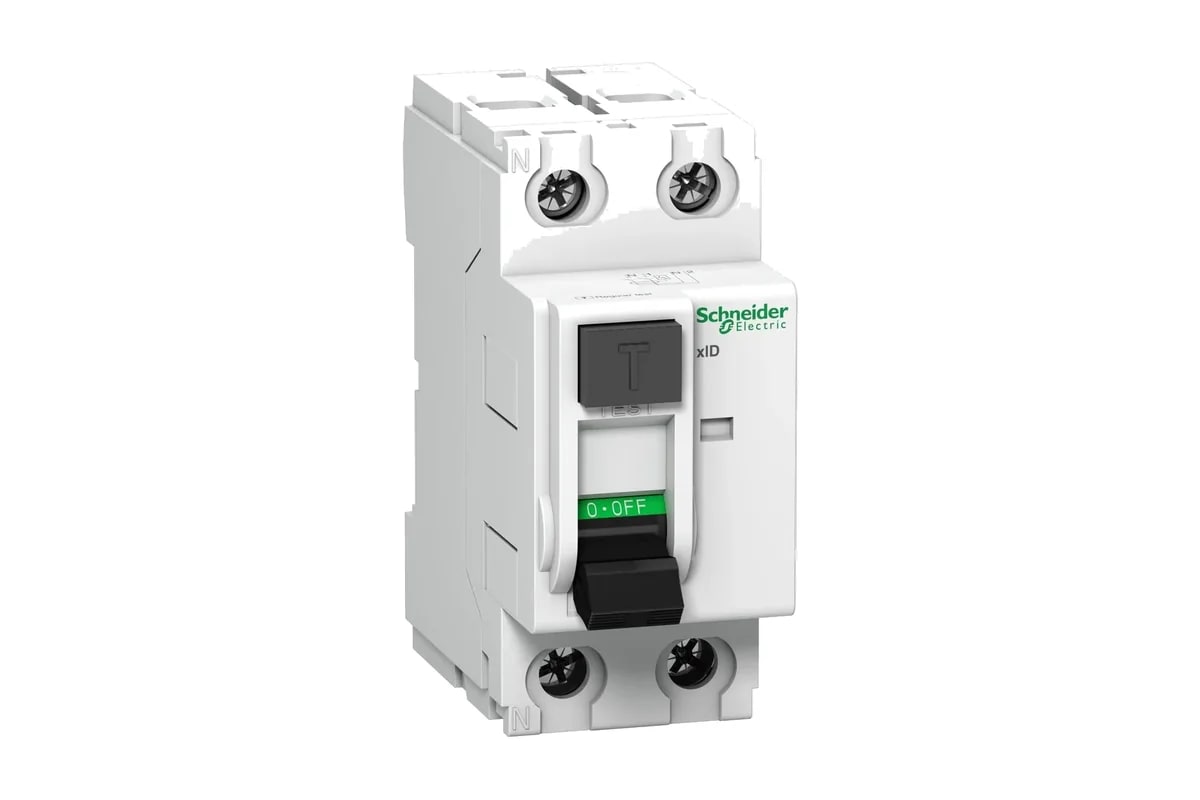
Short answer: both devices disconnect a circuit when current leaks to earth. The original ELCB (earth leakage circuit breaker) was voltage-operated: it sensed the voltage on the earth wire. The RCCB (residual current circuit breaker) is current-operated: it compares phase and neutral currents and trips on any imbalance. RCCBs are more reliable and have replaced voltage ELCBs; in India, many people still say "ELCB" when they mean a current-operated RCCB.
How a voltage-operated ELCB works
A voltage ELCB has a coil connected between the equipment earth and a separate reference earth electrode. When a fault raises the equipment frame voltage, current flows through the coil and the device trips. It only detects faults that pass through its own earth wire, and fails to protect if that earth path is broken or a person touches a live conductor while standing on the ground.
How an RCCB works
An RCCB passes the phase and neutral conductors through a toroidal core. In a healthy circuit the currents are equal and opposite, so the core sees no net flux. When some current leaks to earth, through faulty insulation or a person, the imbalance induces a current in a sensing winding and trips the device within milliseconds. It does not depend on the earth wire being intact.
ELCB vs RCCB comparison
Feature | Voltage-operated ELCB | RCCB (current-operated) |
|---|---|---|
Senses | Voltage on the earth conductor | Current imbalance between phase and neutral |
Depends on earth wire | Yes | No |
Protects a person touching live parts | Not reliably | Yes, at 30 mA sensitivity |
Standard | Obsolete | IS/IEC 61008 |
Current status | Phased out | Standard for earth leakage protection |
Sensitivity and types of RCCB
- 30 mA: personal protection against electric shock on socket, bathroom and outdoor circuits.
- 100 mA: equipment protection and some sub-distribution circuits.
- 300 mA: fire protection on larger distribution circuits.
- Type AC detects sinusoidal AC leakage; Type A also detects pulsating DC from electronics; Type B is used where smooth DC leakage can occur, such as some VFDs and EV chargers.
RCCB vs RCBO and the need for an MCB
An RCCB gives no overload or short-circuit protection, so it is always installed with an MCB or fuse. An RCBO combines both functions in one device and protects a single circuit, which avoids one fault tripping several circuits.
What to send for a quotation
Rated current, number of poles (2P or 4P), sensitivity, type (AC, A or B), quantity and approved makes. Tirupati Power Enterprises quotes RCCBs, RCBOs and MCBs from Kolkata with delivery across India.
Frequently asked questions
What is the full form of ELCB?
Earth leakage circuit breaker. The term originally described voltage-operated devices; today it is often used loosely for current-operated RCCBs.
Is ELCB and RCCB the same?
Not strictly. A voltage-operated ELCB senses earth-wire voltage and is obsolete; an RCCB senses current imbalance and is the modern standard. Many people use the names interchangeably.
Which RCCB is used for home?
A 30 mA RCCB, usually Type AC or Type A, for personal protection on socket and wet-area circuits, installed with MCBs.
Does an RCCB protect against short circuit?
No. It only detects earth leakage. An MCB or fuse is needed for overload and short-circuit protection.
Specify your requirement
Send the rating, make, quantity and delivery location. Attach the drawing or datasheet where available.
Request a quote Or send it on WhatsApp ↗