
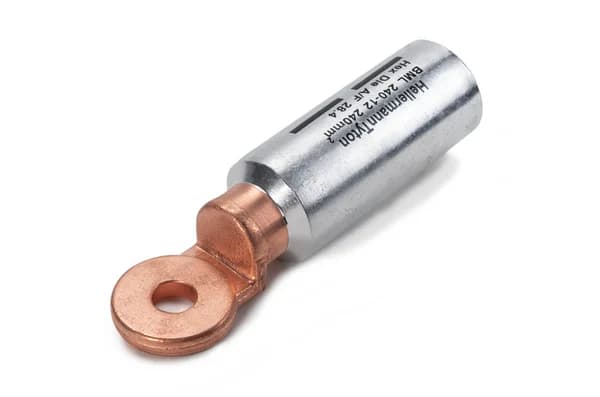
Bimetallic Cable Lugs
Product-type reference. View source and pictured model ↗ The supplied make and configuration are confirmed in your quotation.
Specify the material transition
A bimetallic cable lug commonly provides an aluminium barrel for an aluminium conductor and a copper palm for connection to a copper terminal. The transition is built into the lug as a manufactured joint. Select the exact construction for the cable and terminal arrangement instead of assembling an improvised material transition at the equipment connection.
Tirupati Power Enterprises lists bimetallic types within its cable lugs and sockets range. This subtype identifies enquiries where the conductor and mating terminal use different materials. The lug drawing, material declaration and manufacturer connection instructions are needed to review the proposed interface; the bimetallic name alone does not describe every construction detail.
Check the aluminium barrel independently
The cable interface still needs conductor cross-section and construction information. Confirm whether the chosen barrel accepts the specified stranding, conductor class and any compacted or shaped conductor. Use the approved tool and die combination for that lug series; a tool used for a copper lug of the same nominal size may require a different die or procedure.
Follow the manufacturer preparation and compound instructions for the aluminium side. Protect the conductor and barrel from unsuitable contamination or handling before assembly. The factory-made transition joint should be supplied intact and treated according to its instructions. Do not modify the barrel or joint to compensate for incorrect dimensions.
Fit the copper palm to the actual terminal
Check stud-hole diameter, hole count and spacing, palm dimensions and orientation. The copper palm must sit within the approved contact area and available clearance of the terminal. A wide palm may conflict with adjacent phases or covers even where the cable side fits correctly. Include these clearances in the selection review.
An aluminium incoming feeder connected to a copper switchgear terminal illustrates why both interfaces are required. The enquiry needs the aluminium conductor details and the copper terminal geometry. A bimetallic lug may form the specified transition, but its dimensions, tooling and equipment compatibility must still be confirmed. It is not selected simply by matching cable size and choosing the largest available palm.
Quote the complete termination requirement
Send conductor material, cross-section and class; terminal material and drawing; palm form; tool/die reference; and quantities. State the required transition construction or exact approved part if known. Include any insulation, sealing or termination-kit dimensions that interact with the lug. These details help compare technically suitable alternatives without assuming equivalence from appearance.
Qualified installation personnel should follow the lug and equipment manufacturers’ procedures for conductor preparation, compression and bolted assembly. Inspection and acceptance criteria should address the specified connection system and site procedure. Keep the lug reference and tooling record with the cable schedule. Neither a material description nor a generic compression-lug catalogue establishes test limits for every bimetallic joint.
Before requesting a quotation
- Conductor and mating terminal materials
- Aluminium conductor size and construction
- Manufactured transition and approved lug drawing
- Copper palm dimensions and terminal clearance
- Manufacturer tool, die and preparation instructions
Sources and further reading
Selection references
Use the selected manufacturer’s current datasheet to confirm the exact model. These references explain selection principles.
Applications
- Engineered aluminium-to-copper cable connections
- Aluminium feeders to compatible copper equipment terminals
- Approved replacement material-transition joints
Questions about Bimetallic Cable Lugs
When is a bimetallic lug used?
A common application is an aluminium conductor connected to a copper terminal or busbar, where the approved connection design calls for a manufactured material transition.
Can a bimetallic lug be selected from cable size alone?
No. Confirm conductor construction, the barrel and tooling, the terminal material and palm geometry.
Is a bimetallic lug the same as a tinned copper lug?
No. Tin plating is a surface finish; a bimetallic lug has a defined transition between different bulk materials. Select from the required connection design.
Relevant products and guidance
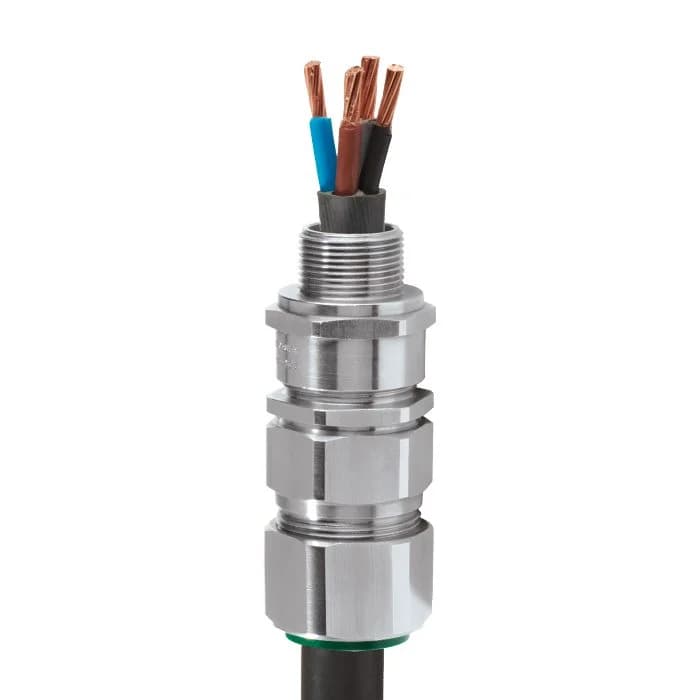
Specify a cable termination kit by exact voltage grade, cable construction, dimensional range and indoor or outdoor duty. LT and HT labels alone are insufficient.
Read articleCables & TerminationsCable lug selection: copper, aluminium and bimetallicSelect a cable lug by conductor material, cross-section, terminal geometry and the manufacturer's crimping system. Prepare a complete enquiry before ordering.
Read articleNeed this for your application?
Share quantity, rating, preferred make and delivery location. The TPE team will respond with pricing and commercial details.