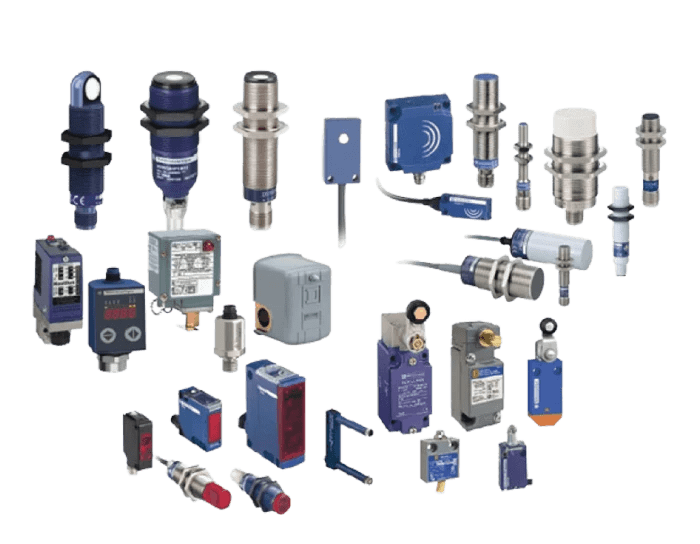
Short answer: a proximity sensor detects an object without touching it. Inductive sensors detect metal, capacitive sensors detect almost any material including liquids and powders, photoelectric sensors use a light beam, ultrasonic sensors use sound echoes, and magnetic sensors detect a magnet. In industry, the output type (NPN or PNP) and the sensing distance matter as much as the sensing principle.
The five main proximity sensor types
Type | Detects | Typical range | Best for |
|---|---|---|---|
Inductive | Metals only | About 1–40 mm by size | Machine position, gears, conveyors, dirty areas |
Capacitive | Metals, plastics, liquids, powders | About 1–25 mm | Level detection through tank walls, granules |
Photoelectric | Most solid objects | Millimetres to tens of metres | Packaging lines, counting, long distances |
Ultrasonic | Most materials, transparent too | Centimetres to several metres | Level and distance, clear or shiny objects |
Magnetic (reed/Hall) | Magnets | Depends on magnet | Cylinder piston position, doors |
Inductive proximity sensors
An oscillator creates a high-frequency field at the sensor face. A metal target nearby absorbs energy through eddy currents, and the sensor switches. Rated sensing distance grows with body size: roughly 1.5–2 mm for M8, 2–4 mm for M12, 5–8 mm for M18 and 10–15 mm for M30 in flush versions. Non-ferrous metals such as aluminium and copper reduce the distance, so apply the maker’s correction factor.
Flush (shielded) sensors can be mounted level with metal; non-flush (unshielded) sensors sense further but need clear space around the face.
Capacitive, photoelectric and ultrasonic sensors
Capacitive sensors respond to a change in capacitance and can detect plastic, glass, wood, grain or liquid, often through a non-metallic tank wall; a sensitivity adjustment sets the trip point. Photoelectric sensors come as through-beam (separate emitter and receiver, longest range), retro-reflective (with a reflector) and diffuse (reflects off the target). Ultrasonic sensors measure the echo time of sound and work regardless of colour or transparency, which suits level and distance measurement.
NPN vs PNP and wiring
- PNP (sourcing): the output switches +24 V to the load. Common in Europe and Indian panels with sourcing PLC inputs.
- NPN (sinking): the output switches the load to 0 V. Common in Japanese and Asian equipment with sinking PLC inputs.
- Match the sensor to the PLC input type, or the input will not see the signal.
- 2-wire sensors (AC or DC) wire in series with the load; 3-wire DC sensors have supply, 0 V and output; 4-wire sensors add a second NO/NC output.
- NO (normally open) switches on when the target is present; NC switches off.
How to choose a proximity sensor
- Target material, size and required sensing distance.
- Body size and mounting: M8, M12, M18, M30 or rectangular; flush or non-flush.
- Supply voltage and output: PNP or NPN, NO or NC, 2, 3 or 4 wire.
- Environment: IP67 or higher for washdown, temperature, oil, weld spatter.
- Connection: pre-wired cable or M12 connector.
What to send for a quotation
The target material, distance, body size, output type, supply voltage and quantity, or the existing sensor part number. Tirupati Power Enterprises quotes industrial proximity sensors from makes such as Omron and Autonics from Kolkata.
Frequently asked questions
What is the difference between inductive and capacitive proximity sensors?
Inductive sensors detect only metal using an electromagnetic field. Capacitive sensors detect metals and non-metals such as plastic, liquid and powder by sensing a change in capacitance.
What is the difference between NPN and PNP sensors?
A PNP sensor sources +24 V to the load when it switches; an NPN sensor sinks the load to 0 V. Choose the one that matches your PLC input type.
How far can an inductive proximity sensor detect?
It depends on body size and mounting, roughly 2 mm for M8 up to about 15 mm for M30 flush sensors on mild steel, less on aluminium or copper.
What does a 3-wire proximity sensor mean?
It has three leads: positive supply, 0 V and the switching output. It is the common DC type used with PLC inputs.
Specify your requirement
Send the rating, make, quantity and delivery location. Attach the drawing or datasheet where available.
Request a quote Or send it on WhatsApp ↗