The short answer
Select a gland whose stated sealing range covers the cable’s actual outside diameter. For an armoured cable, also check bedding diameter and armour range. Then match the entry thread, ingress protection and installation conditions. Two cables with the same conductor cross-section can need different glands.
Read the manufacturer’s size chart
Use the chart for the exact gland series and cable construction. Metric, NPT and PG describe entry threads; they do not give a universal cable diameter range. The examples below explain what to check, rather than assigning a gland to a cable without measurements.
| Chart field | What to compare | Common mistake |
|---|---|---|
| Overall cable diameter | Measured outer sheath diameter against the seal’s minimum and maximum | Using conductor size in mm² as cable diameter |
| Bedding diameter | Diameter beneath the armour, when the gland seals the bedding | Checking only the outer seal |
| Armour range | Armour type and wire/strip dimensions against the clamp range | Treating all armoured cables alike |
| Entry thread | Enclosure entry type, thread size and usable length | Assuming metric and NPT interchange |
| Protection & approvals | Required IP rating, environment and any hazardous-area certification | Assuming every gland carries the same approval |
Example size chart: CMP A2F unarmoured glands
This extract is from CMP’s published A2F chart for unarmoured cables. Diameters are in millimetres. It is a manufacturer-series example, not a universal gland chart and not an armoured-cable selection table. Verify the current datasheet, entry dimensions and application approvals for the exact ordering reference.
| CMP A2F size | Standard metric entry | Cable diameter: minimum (mm) | Cable diameter: maximum (mm) |
|---|---|---|---|
| 16 | M16 | 3.2 | 8.7 |
| 20S16 | M20 | 3.2 | 8.7 |
| 20S | M20 | 6.1 | 11.7 |
| 20 | M20 | 6.5 | 14.0 |
| 25 | M25 | 11.1 | 20.0 |
| 32 | M32 | 17.0 | 26.3 |
| 40 | M40 | 23.5 | 32.2 |
Worked example: a 12 mm unarmoured cable
For an illustrative cable with an actual outside diameter of 12.0 mm and an M20 enclosure entry, the A2F size 20 sealing range of 6.5–14.0 mm contains the measured diameter. The A2F 20S range ends at 11.7 mm, so the same M20 entry does not make that size suitable. This checks only the diameter and thread; confirm the complete gland specification, installation conditions and required accessories before ordering.
Armoured and unarmoured cables
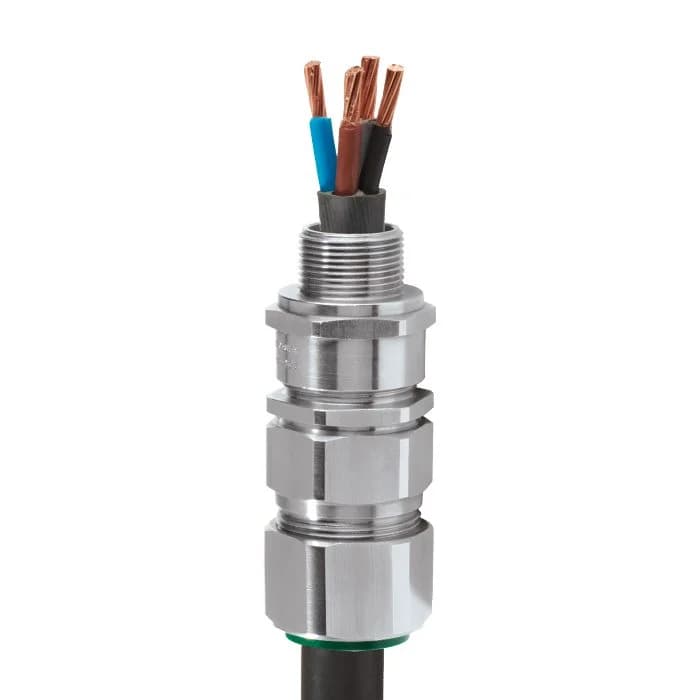
An armoured gland must secure the armour and support the intended earth-continuity arrangement. Unarmoured glands use a different retention and sealing design. Single- and double-compression descriptions are not substitutes for the manufacturer’s sealing specification. Check locknuts, earth tags, shrouds and other required accessories on the installation drawing.
Send these details for a quotation
Send the cable make and datasheet, overall diameter, bedding diameter where relevant, armour type, enclosure entry thread, indoor/outdoor location and quantity. Include the required IP rating and any hazardous-area certificate requirements. A clear cable marking photo and enclosure-entry photo help identify missing details.
Frequently asked questions
Which gland size fits a 4-core 25 mm² cable?
There is no reliable universal answer. Outside diameter varies with the cable make, insulation, voltage class and armour. Compare the exact cable datasheet with the chosen gland series’ sealing and armour ranges.
Is an M20 cable gland the same as a 20 mm cable gland?
M20 identifies a metric entry thread with a nominal 20 mm diameter. Its cable sealing range depends on the gland series and is not automatically 20 mm.
Technical references
Use the current documentation for the exact product and application.
Specify your requirement
Send the rating, make, quantity and delivery location. Attach the drawing or datasheet where available.
Request a quote